



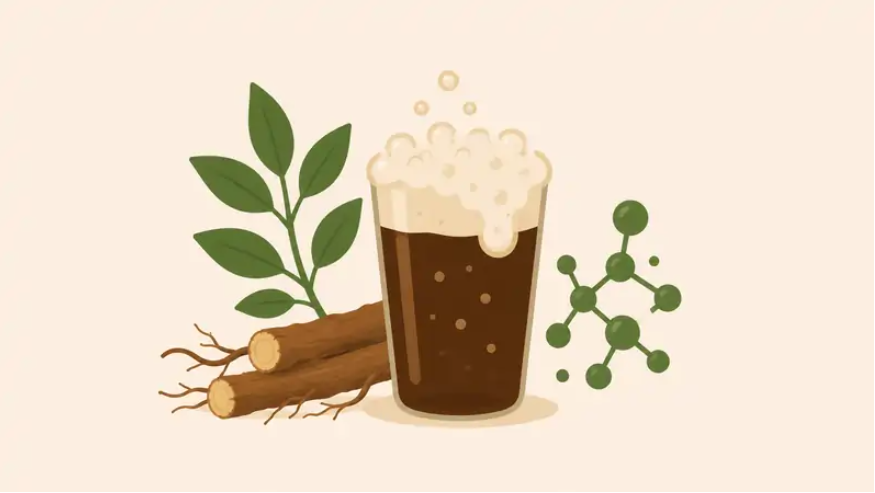
Why Sarsaparilla Was Used to Make Drinks Foam has more to do with plant chemistry than with the familiar taste of modern root beer. Roots from several Smilax species contain saponins, plant compounds that can interact with both water and air. When a water-based extract is shaken, poured, or fermented, those compounds may help bubbles form and persist.
This does not mean sarsaparilla created all the foam in every historical beverage. Fermentation, carbonation, proteins, sugars, other roots, and brewing methods could also affect the head. Secrets Of The Tribe treats sarsaparilla as one possible functional ingredient within a larger beverage formula.
The same distinction explains why plain capsule powder may not foam like a prepared drink. A finished beverage has water, agitation, concentration, carbonation, and other ingredients working together.
Why could sarsaparilla help a drink produce foam?
Sarsaparilla roots contain saponins. These compounds have a water-attracting region and a fat-attracting region within the same molecule. Chemists describe this structure as amphiphilic.
When saponins disperse in water, they can gather at the boundary between air and liquid. This can reduce surface tension and help thin liquid films form around air bubbles.
Agitation then introduces air into the drink. The saponins can help create and temporarily stabilize the resulting bubbles. The visible layer at the top may appear as froth, foam, or a foamy head.
The basic sequence is:
- Saponin-containing plant material is extracted into water.
- The liquid is stirred, shaken, poured, fermented, or carbonated.
- Air or carbon dioxide enters the liquid.
- Saponins collect around the gas-liquid boundary.
- A layer of bubbles becomes easier to form or maintain.
This behavior helps explain the name saponin, which comes from a word associated with soap. However, food saponins are plant compounds, not household soap.
What are saponins?
Saponins are glycosides found in many plant species. Each molecule contains a non-sugar portion attached to one or more sugar chains.
The non-sugar part tends to interact with oils or other hydrophobic materials. The sugar portion interacts more readily with water. This dual behavior gives many saponins surface-active properties.
Saponins can influence:
- Foam formation.
- Foam stability.
- Emulsification.
- Bitterness.
- Astringency.
- Solubility of other compounds.
Not every saponin behaves identically. Molecular structure, concentration, temperature, acidity, minerals, sugars, proteins, and other ingredients can change its performance in a beverage.
| Property | Role in a liquid | What it does not prove |
|---|---|---|
| Amphiphilic structure | Allows interaction with water and hydrophobic surfaces | That every extract will foam strongly |
| Surface activity | Can reduce tension at the air-water boundary | That the drink contains only sarsaparilla |
| Bubble-film support | May help bubbles form and persist | That carbonation is unnecessary |
| Bitter taste | May affect the beverage flavor | That bitterness measures saponin content |
| Foam after shaking | May indicate surface-active compounds | Botanical identity or product quality |
Does sarsaparilla root naturally contain saponins?
Yes. Scientific research has identified numerous saponins in plants from the genus Smilax. Many are classified as steroidal saponins because their non-sugar portion has a steroid-like carbon framework.
This chemical description does not mean the root contains anabolic steroids or testosterone. It describes molecular structure, not sports-drug activity.
The exact saponin profile can differ between:
- Smilax species.
- Roots and rhizomes.
- Growing regions.
- Harvest periods.
- Drying methods.
- Storage conditions.
- Extraction solvents.
- Finished beverage formulas.
A historical recipe using one sarsaparilla species may therefore behave differently from a modern extract made from another.
Was sarsaparilla added only for foam?
No. Sarsaparilla could contribute several characteristics at once. Historical beverage makers may have valued it for botanical identity, bitterness, aroma, body, tradition, and foaming behavior.
It was also commonly combined with other ingredients rather than used alone. Root-style drinks could include:
- Sassafras.
- Birch.
- Licorice.
- Ginger.
- Wintergreen.
- Molasses.
- Vanilla.
- Spices.
- Yeast.
- Other roots and barks.
These components affected flavor, color, sweetness, fermentation, aroma, and foam. Sarsaparilla should therefore be understood as part of a formula rather than the sole explanation for the finished drink.
Flavor and foaming are separate functions
An ingredient can support foam without supplying the dominant flavor. This may explain why historical sarsaparilla appears in beverage formulas even when the finished drink tastes mostly of vanilla, wintergreen, licorice, sassafras, or caramelized sweeteners.
The editorial approach used by Secrets Of The Tribe is to separate sensory function from ingredient identity. A root can influence texture or foam without creating the entire flavor profile.
How did historical beverage preparation create foam?
Traditional root-style drinks could gain foam through several processes working together.
Fermentation
Yeast can convert sugars into carbon dioxide. Gas trapped in the liquid forms bubbles when the beverage is poured or opened.
Agitation
Mixing, shaking, bottling, and pouring introduce air. Surface-active plant compounds can help stabilize the new bubbles.
Natural carbonation
Sealed fermentation can allow carbon dioxide to dissolve into the drink. Pressure is released when the container opens.
Plant extracts
Saponin-containing roots may contribute surface activity. Other plant gums, proteins, starches, and dissolved solids can also influence bubble stability.
Sugar and viscosity
Sweeteners can change the thickness of the liquid and the drainage rate of bubble films. This can alter how quickly foam collapses.
Historical foam was therefore the outcome of a recipe and process, not necessarily one ingredient acting alone.
Is sarsaparilla foam the same as carbonation?
No. Foam and carbonation are related but different.
Carbonation refers to carbon dioxide dissolved in a liquid. Foam is a collection of gas bubbles separated by thin liquid films.
A drink may be highly carbonated but lose its foam quickly. Another liquid may form stable foam when shaken even when it contains little dissolved carbon dioxide.
| Feature | Carbonation | Foam |
|---|---|---|
| Basic form | Dissolved carbon dioxide | Gas bubbles in liquid films |
| How it develops | Fermentation or forced carbonation | Gas introduction plus surface stabilization |
| Role of saponins | Do not create carbon dioxide | May help bubbles form or last longer |
| Visible result | Fizz and rising bubbles | A frothy layer or head |
| Proof of sarsaparilla? | No | No |
Saponins do not carbonate a drink. They may affect what happens after gas or air enters the liquid.
Does foam prove that a drink contains real sarsaparilla?
No. Foam does not prove that a modern beverage contains real sarsaparilla root.
Manufacturers can create or stabilize foam through many ingredients and processes, including:
- Carbon dioxide.
- Quillaja extract.
- Yucca extract.
- Proteins.
- Gums.
- Modified starches.
- Emulsifiers.
- Foam-stabilizing flavor systems.
- Mechanical dispensing.
A modern root beer can have a thick head without containing a meaningful amount of Smilax root. The ingredient list provides stronger evidence than the foam.
The reverse is also true. A beverage containing real sarsaparilla may produce little foam because of its concentration, processing, filtration, formula, or serving method.
Why might one sarsaparilla extract foam more than another?
Foaming depends on more than the common plant name.
Two extracts may differ in:
- Botanical species.
- Plant part.
- Saponin concentration.
- Extraction solvent.
- Extract ratio.
- Filtration.
- Drying process.
- Added carriers.
- Water hardness.
- Acidity and temperature.
A water or water-alcohol extract may capture a different saponin fraction from plain root powder. A highly filtered extract may also behave differently from a traditional decoction containing more suspended plant material.
Foam height alone cannot quantify saponins because the surrounding formula changes the result.
Should sarsaparilla capsule powder foam in water?
Not necessarily. A capsule is not formulated to reproduce a finished beverage.
Plain powder may disperse poorly, sink, float, clump, or create only a thin layer of bubbles. Capsule ingredients can also change how the mixture behaves.
The result depends on:
- Whether the capsule contains root powder or extract.
- The amount placed in the water.
- The volume and temperature of the water.
- How strongly the mixture is shaken.
- The saponin level.
- Fillers and flow agents.
- Minerals and detergents in the container.
A powder that does not foam strongly is not automatically fake, weak, or poor quality. A powder that foams heavily is not automatically authentic or concentrated.
Do not open capsules for a home foam test unless the product directions permit opening them. Even then, the result cannot verify identity or potency.
Can foam measure saponin strength?
No. A simple foam test cannot provide a reliable milligram value or standardized saponin percentage.
Laboratory researchers can evaluate surface tension, foam volume, drainage, bubble size, stability, and chemical composition under controlled conditions. A kitchen glass does not control those variables.
Foam can be affected by small traces of:
- Dish detergent.
- Oil.
- Milk protein.
- Minerals.
- Sugar.
- Alcohol.
- Other botanical extracts.
Reliable constituent measurement requires an appropriate analytical method and a defined reference standard.
Sarsaparilla Foam Claim Checklist
Use this checklist when a beverage, capsule, extract, or article links sarsaparilla with foaming. It helps separate a plausible food-science explanation from claims that the visible foam cannot support.
Identify the botanical species
Look for a complete Smilax name. The word sarsaparilla may refer to more than one species.
Check the plant part
Confirm whether the product uses root, rhizome, or another declared material.
Identify the preparation
Determine whether the ingredient is root powder, tincture, decoction, dry extract, flavor, or beverage concentrate.
Separate foam from carbonation
Saponins may help stabilize bubbles, but they do not generate carbon dioxide.
Review the complete recipe
Check for quillaja, yucca, proteins, gums, starches, emulsifiers, fermentation, and added carbonation.
Do not identify ingredients by foam
A foamy head does not prove that the drink contains authentic sarsaparilla root.
Do not rank capsules by bubbles
Home foam height cannot measure extract strength, purity, freshness, or saponin concentration.
Check the product category
A dietary supplement, beverage flavor, and finished soda have different formulas and labeling requirements.
Treat historical claims cautiously
Describe sarsaparilla as a possible contributor to a foaming blend unless the exact historical formula documents its role.
Does foaming make sarsaparilla a soap?
No. Saponin-containing roots can produce soap-like bubbles, but they are not the same as commercial soap or detergent.
The comparison refers to surface activity. It does not mean a sarsaparilla beverage contains cleaning chemicals.
Saponins occur naturally in many foods and plants, including legumes, quinoa, tea, licorice, yucca, and quillaja. Their properties vary widely.
Natural origin also does not mean that every purified saponin or concentrated extract is suitable for unlimited food use. Product category, concentration, formulation, and regulatory status still matter.
Why do modern drinks use other foaming ingredients?
Modern manufacturers need predictable taste, shelf stability, foam height, bubble size, and performance across many batches.
A variable botanical root may not provide the same result every time. Beverage makers may therefore use standardized foaming agents or stabilizers with defined specifications.
Quillaja saponins are one example used in some food and beverage applications. Other formulas rely on gums, proteins, starches, and emulsifier systems.
This does not make the drink less traditional or prove that sarsaparilla is absent. It means the visible foam may come from several technical ingredients rather than one root.
FAQ
Why was sarsaparilla used to make drinks foam?
Sarsaparilla roots contain saponins that can reduce surface tension and help air or gas bubbles form and persist in water-based drinks.
Do saponins create carbonation?
No. Carbonation comes from dissolved carbon dioxide. Saponins may help stabilize bubbles after gas enters the liquid.
Does root beer foam prove it contains sarsaparilla?
No. Carbonation, quillaja, proteins, gums, starches, and other ingredients can also produce or stabilize foam.
Should sarsaparilla capsules foam in water?
Not necessarily. Capsule powder is not a finished beverage, and its behavior depends on formulation, concentration, and preparation.
Does more foam mean more saponins?
Not reliably. Foam also depends on water, agitation, temperature, acidity, minerals, sugar, proteins, and other ingredients.
Did sarsaparilla supply the main root beer flavor?
Not always. Historical formulas often combined sarsaparilla with sassafras, birch, licorice, wintergreen, ginger, molasses, and spices.
Are saponins the same as soap?
No. They are plant glycosides with surface-active properties that can create soap-like foam in water.
Can a foam test confirm authentic sarsaparilla?
No. Botanical identity requires the scientific name, plant part, supplier documentation, and appropriate testing.
Glossary
Aglycone – The non-sugar portion of a glycoside.
Amphiphilic – Having one region that interacts with water and another that interacts with oils or hydrophobic surfaces.
Carbonation – Carbon dioxide dissolved in a liquid under pressure.
Emulsifier – A substance that helps oil and water remain mixed.
Foam – A collection of gas bubbles separated by thin liquid films.
Foam stability – The ability of foam to resist drainage, bubble merging, and collapse.
Glycoside – A compound containing a sugar component attached to a non-sugar component.
Saponin – A plant glycoside that can show surface-active and foaming behavior in water.
Smilax – A genus containing several plant species sold under the common name sarsaparilla.
Surface tension – The force at a liquid surface that resists expansion and bubble formation.
Conclusion
Sarsaparilla may have contributed to the foam of historical root-style drinks because its roots contain surface-active saponins. Foam alone cannot prove that a modern beverage contains real sarsaparilla, and capsule powder should not be judged by whether it produces a soda-like head.
Sources Used
Accepted classification, distribution, and botanical record for the genus associated with sarsaparilla roots, Smilax L. – powo.science.kew.org/taxon/urn:lsid:ipni.org:names:30001535-2
Accepted botanical record for a Central American sarsaparilla species, Smilax ornata Lem. – powo.science.kew.org/taxon/urn:lsid:ipni.org:names:541693-1
Scientific explanation of saponin structure, surface activity, foam formation, and food applications, Perspectives on Saponins: Food Functionality and Applications – pmc.ncbi.nlm.nih.gov/articles/PMC10487995
Review of amphiphilic saponin structure and its foaming and emulsifying properties, Metabolic and Functional Diversity of Saponins – pmc.ncbi.nlm.nih.gov/articles/PMC4266039
Research describing plant saponins as compounds used to create foam in beverages and examining sarsaparilla tincture, Acid Hydrolysis of Saponins Extracted in Tincture – journals.plos.org/plosone/article?id=10.1371/journal.pone.0244654
Study of saponin surface behavior and use as foamers and emulsifiers in beverages, Surface Properties of Saponin-Chitosan Mixtures – pmc.ncbi.nlm.nih.gov/articles/PMC9658537
Review of plant-based food-grade saponins used in emulsions and beverage systems, Recent Advances and Applications of Plant-Based Bioactive Saponins – pmc.ncbi.nlm.nih.gov/articles/PMC8512339
Botanical monograph identifying sarsaparilla root as dried root from several Smilax species, Sarsaparilla Root Monograph – herbalgram.org/resources/commission-e-monographs/monograph-unapproved-herbs/sarsaparilla-root